
Let me tell you a story.
A true travel story at that – the kind that lives not in guidebooks or Instagram reels, but in the archives of memory. The kind that cuts so deep it peels away layers of obstinate ignorance and settles deep in the marrow. A tale of merciless storms and long, shivering motorcycle rides. Of stormy seas and narrow alleyways – but also of good beer, laughter over stories lost in translation, and strange houses that somehow become homes. But more than that – it’s a story about human connection.
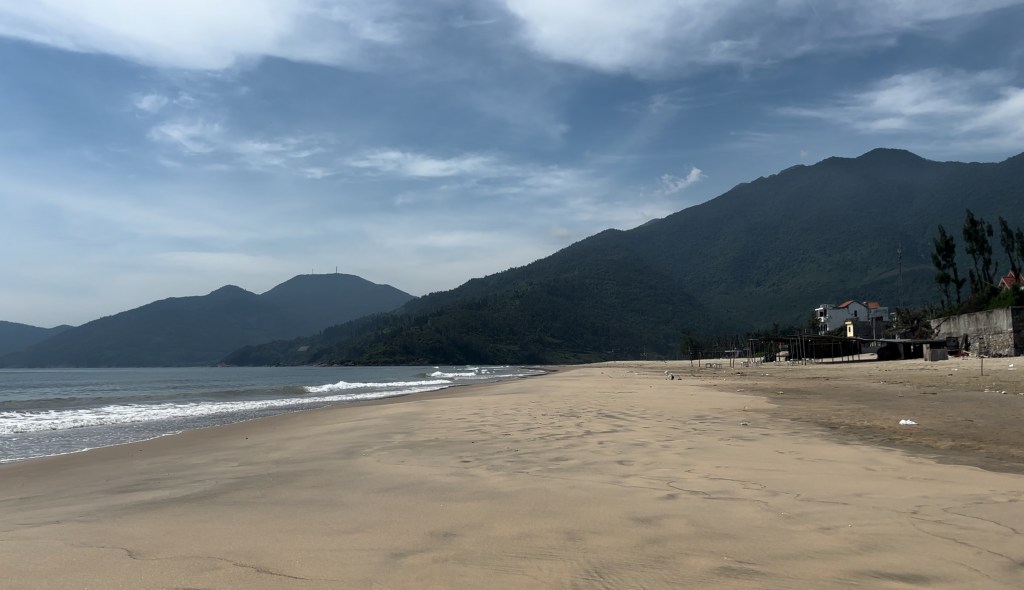
Lang Co Bay – a quiet, local bay-side village where the mountains dramatically drop into the sea at the end of the Hai Van Pass, that is where our story takes place.
One random evening, restless with wanderlust, I felt like going on an adventure. My eyes landed on a small dot on the map; a place called An Cư. Something about it tugged at me, as if promising an answer to a question I hadn’t yet asked, or offering something I didn’t yet know I would need. I turned to Jake, my dear friend, whose own sense of adventure rarely slept, and he agreed before I’d barely finished the sentence. Moments later, we were off, the motorbike humming beneath us in a metallic throb, carving through the humid evening air.
The rain had already begun its slow crescendo, thickening into a tropical storm that curled around us like something energetically alive. Dusk was slowly approaching, lying like a thick carpet over the landscape. Still, the urge to see An Cư wouldn’t let us turn back.
We wound our way up the Hai Van Pass, a dramatic hillside road snaking along cliffs dressed evergreen. Jungle leaves and vines hugged the highlands, concealing a whole world below and leaving most to the imagination. Heavy clouds danced across the hilltops, choreographing a dynamic landscape that felt more alive than ever before. The smeared twilight cascading from above was at a dramatic low, like the dimming floodlights in the theatre before the final show. Even the magnificent ocean view was entering its final scene, with a subdued horizon. The bike danced through the sharp curves. As we neared the summit, the journey shifted from daring to quite terrifying. Wind clawed at us from every side as if it had a will of its own and wouldn’t rest until it dragged us across the wet, cold, unforgiving asphalt. Sheets of rain slammed into our helmets, drumming an erratic rhythm. My grip tightened until my wrists burned, riding barely faster than a man might walk, every meter earned through sheer stubbornness.
More than once, we paused, engine idling, glancing back toward the safety we’d left behind – but something intangible urged us onward. So we pressed on, swallowed by rain and wind, chasing that visceral notion pulling us forward.
Cresting the summit felt like crossing a silent threshold. The wind and the rain awaited us on the other side, howling even louder, and the rainfall lashed at us with renewed fury – fiercer and more insistent than before, as though the mountain itself was putting us through a treacherous trial. Turning back had long slipped our tired minds, so we pressed on, gripping the handlebars with numb fingers, letting the bike roll cautiously. Downhill, the road curled through heavy fog, each curve hiding its own peril.
Then, through a break in the storm, the land below revealed itself: Lang Co Bay, pale under a bruised sky, unfolding in quiet defiance beyond the damp, gleaming rainforest cliffs. Heavy clouds prowled the serrated peaks.
A pale scythe of sand felling the storm-churned sea. Waves, monstrous and tireless, rose and collapsed onto the obedient shores – a violence so rhythmic it felt almost deliberate. Beyond, the narrow bridge bound sea to mountain, its concrete spine braced against the gale, while palm trees around convulsed in a wild salute, bending but unbroken.
After letting that view sink in for a while, something like relief flooded through me – a breath caught and finally released. We were close now. The fear and cold that clung to our soaked clothes felt trivial beside the strange exhilaration of standing before such fierce, indifferent beauty. It was a view almost too vast to claim, yet it felt as if, at least for a moment, it belonged to us alone. A promise spoken in a murmur that we were nearly there.
With relief quickening our pulse, we nudged the bike forward, beginning the descent into Lang Co itself. But by then, the rain had done its quiet, merciless work: our clothes clung to us like cold, second skins, every gust of wind slicing through the fabric until our teeth rattled with the chill.
The main road of the town appeared through the drizzle, its slick asphalt shining under the smeared glow of the ever-dimming sky. Jake, still shivering yet grinning through the cold, gestured to a narrow turn branching off toward the sea; a smaller road that promised an unrefined path, and perhaps a closer glimpse of the unruly beach. Without a word, I nodded. We banked right.
We steered into an alleyway so narrow the handlebars nearly brushed the peeling walls on either side – a cramped vein of the village twisting toward the sea. At times, the walls parted just enough for us to catch a breath, only to close in again so claustrophobically tight we had to slow almost to a crawl, coaxing the bike through.
The ground under our tires shifted between cracked concrete and sudden hollows that sent jolts up through our frozen arms. Tiny houses spilled open onto the lane, their living rooms doubling as storefronts: baskets of colourful fruit, heaps of vegetables glistening wet in the storm, as well as the harvest of the sea feeling the relief of water running down their long parched scales. The offerings of nature were spilling out of shopfronts patched together from corrugated tin and weathered wood.
Everywhere, life moved quickly but unhurriedly local: vendors folding tarps over produce, stray dogs nosing at scraps, scooters fitted into impossible corners as if growing out of the walls themselves. A woman in a conical hat glanced up just long enough to meet our gaze, then bent to tie another bundle. The alley led us onward, deeper still, until at last the tangled brush parted – and there it was: the beach, grey and restless beyond a lattice of salt-bitten shrubs, waiting at the end of this hidden corridor.
We rolled to a stop and clambered off the bike. Before us, the landscape sprawled in layered contrast. To the left, the storm-frothed ocean heaving under violent clouds, below, a strip of pale sand, pitted and wind-scoured and then again patted flat by the never-ending cries of the skies. And beyond, the calm, hidden bay. Its waters seeking shelter behind the bridge and cradled by jungle-clad mountains towering above, humbling every skyscraper back in Da Nang.

Yet the beauty barely registered through the freezing tremor seeping deeper, feeling like it was about to sink down to our bones. We were soaked to the marrow, shivering so hard it made speech come out in halted breaths. Nearby, a fisherman jumped off his narrow, elongated wooden boat, its deck scattered with weather-beaten plastic crates and coiled nets that smelled of brine and rotting fish. Rain traced rivulets down his back as he moved with practised urgency, looping a sodden rope around a splintered mooring post, tugging it tight against the tide’s restless pull.
He turned toward us then, water streaming from the brim of his nón lá, and spoke a few hurried words in Vietnamese – words we couldn’t catch. But the deep furrow of his brow, the quick flick of his gaze to the darkening sky, spoke clearer than language ever could.
He pointed us toward a roof held aloft by steady concrete posts and topped with ridged tin. We followed, ducking obediently under it, grateful for even this thin reprieve from the relentless downpour. The roof turned out to crown the nearest house to the sea, perched right at the ragged edge of Lang Co Bay, where sand blurred into damp concrete.

Inside, a local family sat gathered on the cool tile floor, dinner bowls clustered between them. Their heads turned as we stepped closer, and for a heartbeat, the hush of rain on tin roof was the only sound. Curiosity lit their faces – we could almost see them thinking: Who are these rain-drenched strangers, and why have they come riding straight into the storm – and of all places, why here?
But kindness overrode every question. They beckoned us closer. The man, his palms still damp from handling fish, reached out toward me, offering a piece of their meal: a sesame cracker piled with something raw and glistening, fragrant with lime, herbs and something spicy. An invitation so gentle and open it warmed us more than any shelter could.
Without a second thought, I accepted. I’ve always felt it matters to be culturally considerate when travelling – do as the locals do. I took the offered bite and, without pause, stuffed it in my mouth. Their smiles widened into gentle, amused laughter, a moment of warmth breaking through the chill of the rain. Then they gestured to us, to come inside, and we followed without hesitation.
As we settled in amongst them, they passed us each a bowl – and before setting it down, they heaped it with the mouthwatering raw fish salad, adding a cracker to the side. Chopsticks were laid carefully across the brim. Then came small glasses, swiftly filled to the brim with Huda beer, foam trembling at the edge. Teeth still chattering from the cold, we dug in without ceremony, the warmth of food and company beginning slowly to thaw our frozen limbs.
Shortly after, the kind woman rose and slipped into another room. When she returned, she carried a silk set – loose trousers and a matching top, which she offered me with a gentle, unmistakable gesture to change. Soaked through and chilled to the bone, I gratefully accepted at once, feeling faintly moved by such unexpected kindness. «Cảm ơn», I muttered quietly through still‑trembling teeth, one of the few phrases I had learned in Vietnamese, meaning thank you.
She led me to a small bedroom at the back and I pulled on the borrowed clothes – smooth, cool, and wrapping around me a tad bit tight and short. When I emerged again, warm laughter rippled through the room. A phone with Google Translate was handed over ready to use, and after a quick tap, their words appeared on the screen: «You look like a Vietnamese girl.» The amused glances they exchanged said even more than the words themselves.
The rest of the night we spent drinking beer and getting to know each other through Google Translate. We taught them how to use the speech-to-text function, and the phone was passed back and forth all night, with the occasional laughter when meaning was lost in translation.

I learned that the father of the house, Hồng Đình Hùng, at 55 years old, is a fisherman by trade and by birthright, and so he has been for over 20 years. He taught his son the same craft passed down through generations. When the tide allows, he takes on construction work and runs a small hat business up in Da Nang, turning his hands to whatever keeps the family afloat.
His wife, Đỗ Thị Hồng, 48, helps run a modest restaurant right there by the water’s edge and also sells the daily catch he brings home fresh from the bay at the local market. Together, they’ve raised three children: a son who stayed in Lang Co, casting nets alongside his father. And then a daughter and another son who have moved south to Ho Chi Minh City. The youngest son is a bonsai artist – shaping the tiny branches with the same patient care his father tends to the sea.
That evening, their friend and neighbour, Loi, was also there to keep us company. We learned he’s a 35‑year‑old squid fisherman, whose family lives out of town while he stays on the bay for work. Loi turned out to be quite the character. With everyone else, Google Translate worked just fine with the occasional quirk. Yet with Loi, the app seemed to lose its footing entirely, spitting out bizarre, tangled phrases that made no sense at all. More than once, it produced something so unexpectedly funny, or downright shocking, that the whole room burst into laughter.
Throughout the night, several people from the village came and went, sitting with us for a beer and a chat before disappearing again into the stormy dark. At one point, Đỗ Thị Hồng even called her daughter on FaceTime, just so we could say hello.
After hours of conversation about life, culture, and family, the room began to settle into a slower rhythm – tired, relaxed. All the other guests, including Loi, had gone home. The mother of the house appeared with a towering pile of fresh laundry, which she dropped onto the floor with a soft thump, then knelt down to fold.
Without hesitation, bringing my beer of course, I flopped down beside her and began folding garments, matching her pace. At first, they waved their hands and laughed softly, unsure whether to accept or continue insisting on their hospitality. But I wasn’t trying to impress or intrude – I simply wanted to be there, to take part in the rhythm of their daily life. After a moment, they let go of their futile attempts to stop me. A content, relaxed smile settled on their faces. So I continued folding the soft cloth in the kindred hush, while the rain tore at the tin roof like it had something to prove.
As the night deepened, Hùng gestured for my phone with Google Translate. When he handed it back, a simple message lit up the screen – an invitation to stay the night. I was genuinely moved. We were strangers, soaked and unannounced, and yet they had welcomed us without hesitation, offering shelter from the storm, dry clothes, a place at their table, and now a roof over our heads. And they expected nothing in return.
After politely accepting their offer, they cleared a space for us: a simple room with high ceilings, where mattresses rested directly on the cool tile. Overhead, a single fan turned in slow, hypnotic arcs, stirring the humid air, faintly scented with salt and earth. Outside, the steady drumming of rain on the tin roof felt oddly comforting, a quiet lullaby that softened everything.
The architecture of the house felt almost grown rather than built: walls left slightly ajar at the top, deliberately unfinished, so the hot, humid monsoon breeze could wander through. The living room area divided itself in two – the inner room, dim and contemplative, housed a Buddhist shrine heavy with lacquered statues, unlit candles clustered together, and sticks of sage crumbling gently into their tray. A low red bulb cast everything in a perpetual dusk, as if the room itself exhaled devotion. Beyond this, the living room opened into noisy life: a broad television ready for karaoke, twin loudspeakers like quiet sentinels awaiting nightfall, and a corrugated tin door on wheels that could slide back entirely, dissolving the boundary between inside and the world outside. When opened, it framed the landscape like a postcard: scattered, thin-branched trees, a long strip of beach, and mountains rising behind it all, shielding the bay from the unforgiving weather.
There was no wall separating the kitchen from the living space; only an open area marked by counters scattered with utensils, metal bowls dulled by use, a humming fridge, and a deep freezer filled with the sea’s daily catch. All the way at the back, near two small bedrooms, lay the modest bathroom.
They apologised for the simplicity of it all, voices warm yet almost ashamed. An apology that caught strangely in my chest, because it felt unnecessary, even gently tragic. Humility, I thought, does not diminish beauty; rather, it amplifies it. At that moment, I knew I would return, drawn back by something far deeper than comfort – having found a family among strangers, and a home on the other side of the world.
The days start early in Vietnam, so we rose with the sun at 5 am. The storm had quieted down, with the occasional gust of wind and rain, as a reminder of yesterday’s harsh conditions. Jake gently brought up we would have to leave, as he had business to tend to back in Da Nang, but their hospitable nature wouldn’t allow it – not before serving us breakfast.
The heavy-plated door shrieked open under the pressure of their persistent hands, and the same beautiful view as yesterday opened before our eyes, this time more vivid and clear, not dimmed by dusk. The fresh, salty air scented by the smell of ever-falling rain entered. The atmosphere of this morning was completed by the soft music played in the background, a male voice floated playfully over the melody, rising and falling in light, unpredictable tones, like storytelling sung aloud. The instrumentation was minimal, a gentle, steady beat beneath a simple, traditional tune – unmistakably Vietnamese, but never demanding attention. A soft and unhurried piece of nhạc dân ca.
They soon joined us on the cool, tiled floor, placing a woven mat of bright yellow and green in the centre. At its heart: a rounded white teapot, surrounded by tiny, one-sip-sized cups, one for each of us. The green tea carried a strong, almost bitter taste.
Not long after came the bowls, steaming with their fragrant contents – tangled yellow noodles and whole, small squid floating in a steaming, hearty broth.
Before digging in, as a quiet tribute to the art of attentive noticing, he reached into his bowl, picking the largest squid with a precise flick of his wooden chopsticks, and relocated it to mine with a splash. The night before, I had mentioned in passing that squid happened to be one of my favourite foods. It is gestures like this that linger long after the moment has passed – small, unsought testaments that golden hearts still exist in this otherwise nonchalant world.

After breakfast, the time had come for us to leave. Outside, rain still drizzled softly, pattering gently against the concrete as we stood uncertainly near the doorway. Without explanation, Hồng suddenly hopped on his scooter and sped off into the grey morning, leaving only a faint trace of exhaust in his wake. Saddened, I sat down quietly, waiting for a moment in case he returned, unsure where he had gone. After a few minutes had passed, I assumed the daily rhythm had claimed him again, taking him to the sea or some other work. Disappointment tugged at me as we slowly walked toward the bike, helmets dangling loosely from our hands.
Then, just as unexpectedly, he returned – rolling into the driveway, the scooter rattling softly to a halt. I couldn’t suppress my excitement at seeing him again. His face broke into a wide, genuine smile as he lifted both arms, presenting a blue, neatly packaged bag in each hand. Two rain ponchos, one for each of us. The quiet kindness of the gesture caught me off guard, it truly moved me. I looked down, pretending to adjust my helmet strap, letting the moment settle before it showed too much on my face as emotion began to pool at the corners of my eyes.
And because every good experience eventually becomes a nostalgic memory, and every good story must, at some point, find its end – so does this one.
That morning, we left with full stomachs and full hearts.
In the weeks that followed, we returned to Lang Co multiple times, each journey blessed with better weather. We would gather outside beneath star-littered skies, talking late into the evening over good beer and even better company.

The village kids would come by to say hello, and we’d play tag, chase each other around with sticks pretending we were pirates, and balance along fallen palm trunks as if walking the plank.
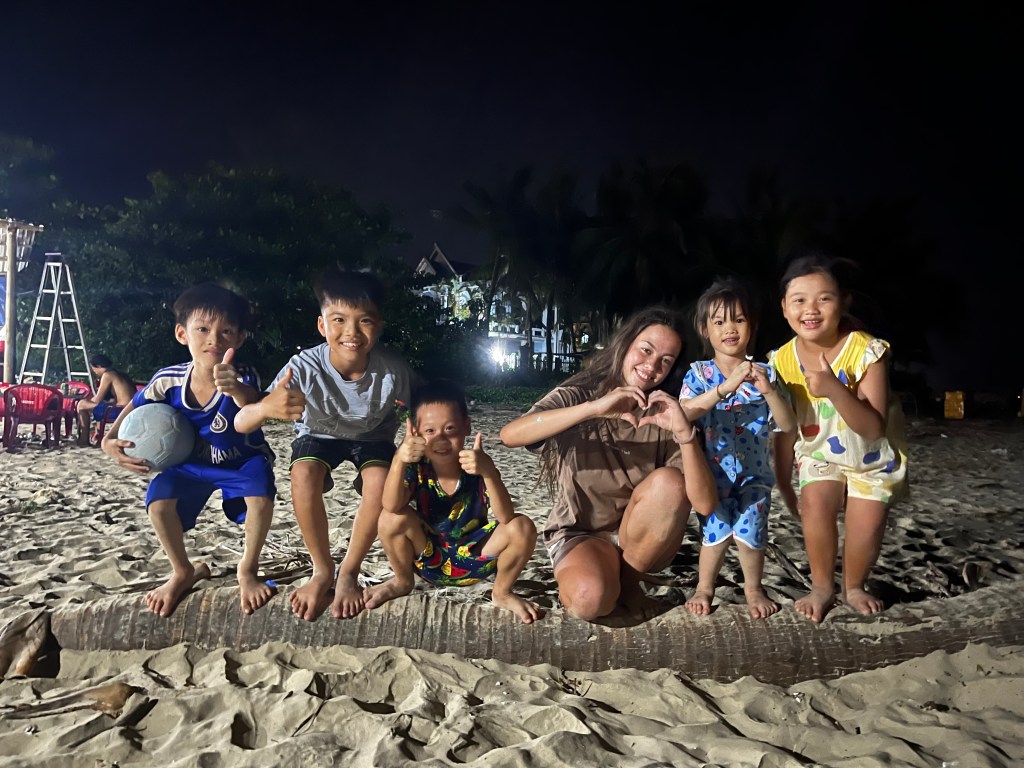
Đỗ Thị Hồng would cook and serve the most delicious food, Hồng Đình Hùng would share quiet wisdom – often with a teasing smile and the occasional joke at our expense, and Loi would continue with his whimsical Google Translate endeavours.

One of the last evenings I spent in Lang Co, their daughter-in-law mentioned something, almost in passing, about their financial struggles. Having been welcomed into their home so many times, I had already thought about how I might give something back, somehow help them out in return. I’d brought small gifts: like a full set of beer glasses after my friend and I accidentally broke one. But after that moment with their daughter-in-law, the feeling grew stronger – a pull to do more.
I had considered it before, but didn’t want to be culturally inconsiderate, or worse, make them feel uncomfortable. Still, in the final 24 hours before I had to leave Vietnam, the thought wouldn’t let go. I realised I couldn’t leave without doing what my heart insisted on – even if it meant risking offence. Because the truth is, we never truly know who might need a helping hand, especially among those who give so willingly and take so reluctantly.
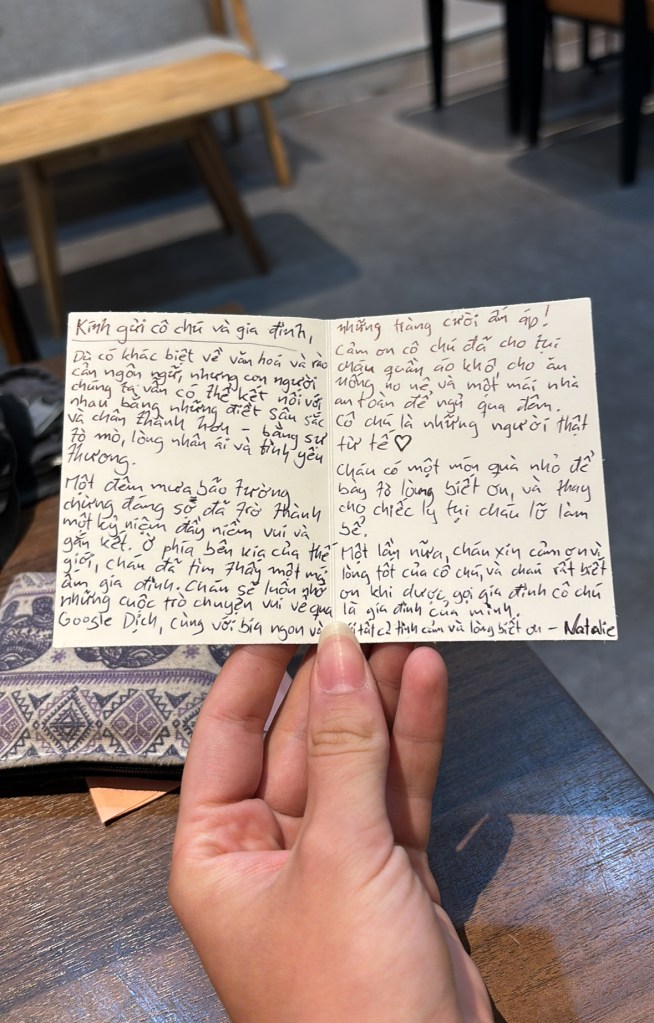
So I left an envelope and a note. Discreetly. Making sure they wouldn’t discover it until after I had gone. Inside was a carefully calculated amount: what should be close to a month’s income for their household.

This experience profoundly changed me.
In a world built on greed, transactional interactions, and dividing differences, in a forest of weeds and poisonous vines – I found the primrose. The unyielding good that refuses to be forged into something lesser, something more shallow.
It taught me that there are still truly good people in this world. People with pure hearts and honest intentions. People who have next to nothing, yet offer the little they have without hesitation.
People who, instead of seeing difference as a barrier, choose to see it as an opportunity to learn and to connect.
We were strangers to them. Foreigners, at that. We didn’t look the same, didn’t speak the same, didn’t behave the same.
Yet they took us in and treated us like family.
They fed us. Clothed us. Gave us a roof above our heads.
And most generously of all – they opened their hearts to us.
I still remember the moment Hồng, the father of the house, handed me the phone with Google Translate. On the screen, it read: «Is it okay if I now regard you as my children?» He said he saw us as family now.
If there is one moral to this story, then it’s this:
Connection goes beyond language.
And human love surpasses differences and fear.
And that is the story of how I came to find a home, and a family on the other side of the world.


 Vagabond Bird of Passage